Through Our Eyes: The Empowerment of Employment

Imagine you’re a young adult, fresh out of college and ready to start your career. The whole world is in front of you, and one question stands out: Where do I start?
Now imagine that same scenario, but you’re also blind or visually impaired. Along with the uncertainty that often comes with searching for a first job, you may wonder whether an employer will see your abilities or make up their mind the moment you walk through the door, cane in hand.
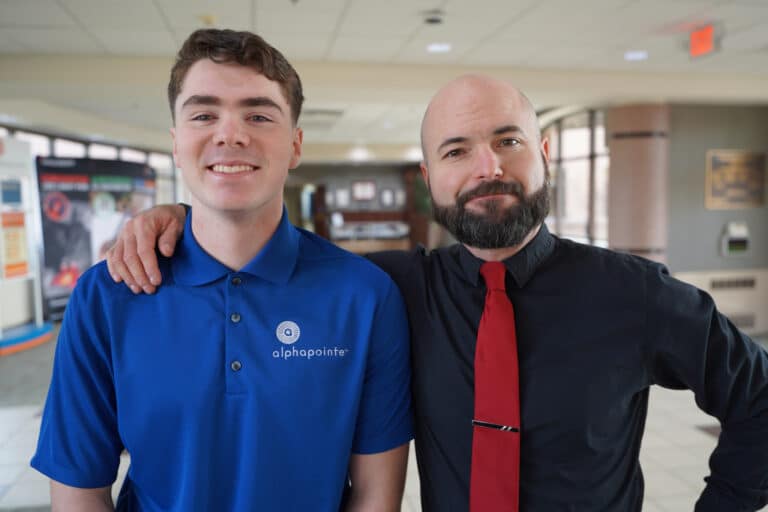
That’s where Martin Callen comes in. As Alphapointe’s Career Placement Specialist, Martin doesn’t just help people with vision loss find a job they need. He helps them find a job they want.
“This is an incredible service that Alphapointe offers because it enables us to meet our clients wherever they are in life … ” – Martin Callen
Meeting them where they are
Martin works with people at many different stages of life, with varying levels of experience, skills and goals.
“This is an incredible service that Alphapointe offers because it enables us to meet our clients wherever they are in life,” Martin explains. “I might work with a young adult out of high school or college looking for their first job, or someone who has been in a particular field for decades before experiencing vision loss and is trying to return to that work or find success in a new field.”
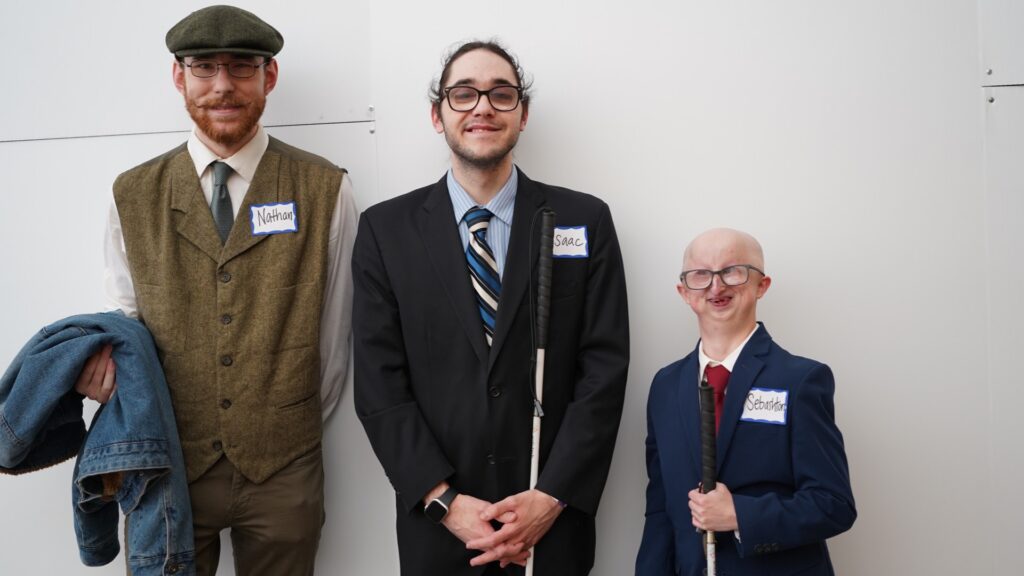
It was through this work that Martin met Nathan Wilcox, a young man with vision loss who had recently graduated from college and was uncertain about what came next.
Finding a labor of love
For someone just out of college, the transition into working life can be challenging. Martin says employment can provide an anchor, offering direction, independence and a stronger sense of purpose.
That starts with getting to know the person. Martin learns about each client’s skills and strengths, but also their interests and passions. For Nathan, one passion quickly stood out: history.

A historian at heart, Nathan loves learning about the past and sharing that knowledge with others. He and Martin soon recognized that one of Kansas City’s museums could be an ideal place to begin his career.
Nathan submitted multiple applications, but like many job seekers, he had to be patient before the right opportunity came along.
Despite the setbacks, Nathan wasn’t discouraged. He knew what he was capable of, and so did Martin. They simply needed an employer willing to recognize that same potential.
“Martin did so much more than just get me a job,” Nathan says. “He helped me recognize my own skills, write resumes, prepare for interviews and really find a job that I could not only do, but enjoy and be successful at.” – Nathan
Finding his place at the Nelson-Atkins
“Martin did so much more than just get me a job,” Nathan says. “He helped me recognize my own skills, write resumes, prepare for interviews and really find a job that I could not only do, but enjoy and be successful at.”
That opportunity came at the Nelson-Atkins Museum of Art in Kansas City, where Nathan now works as a Guest Services Officer. The role gives him the opportunity to put his interests and abilities to work while helping visitors experience a place dedicated to learning, art and history.
“The Nelson has given me an environment where I feel I can not only be successful, but also accepted,” Nathan says. “I do not have to hide my vision loss, and it has not come up once since I was hired.”
“The Nelson has given me an environment where I feel I can not only be successful, but also accepted,” Nathan says. “I do not have to hide my vision loss, and it has not come up once since I was hired.”
Nathan knew what he was capable of. So do countless other people living with vision loss. Sometimes, they simply need an employer willing to see their ability and potential just as clearly.
For Martin, career placement goes well beyond helping someone land a job. It’s about helping people discover where their skills, interests and ambitions can take them, and giving them the opportunity to build a career and a future on their own terms.