Through Our Eyes: Providing Options for those with Vision Loss
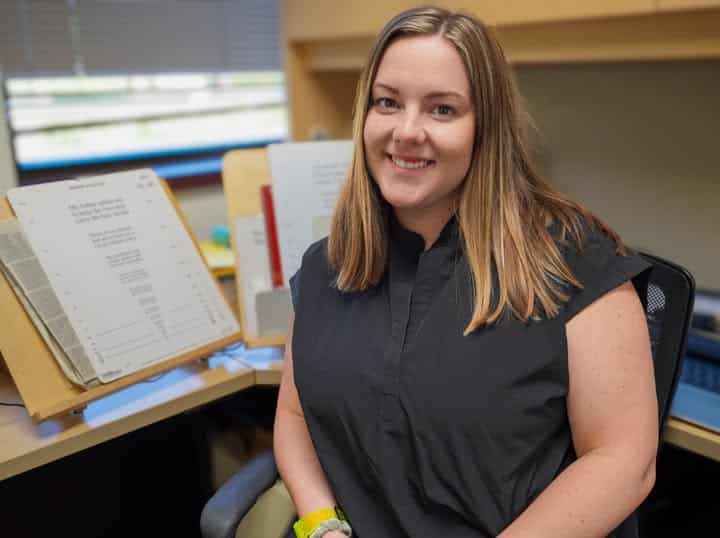
Q and A with Alphapointe Occupational Therapist, Shannon Fugate
There comes a moment for adults dealing with vision loss when glasses, medication, or surgery no longer work. In that moment – when it feels like there is no place left to turn – the Alphapointe team can step in and help someone continue living independently and enjoying the things they love.
After a visit with one of our optometrist, many people will receive in-home support from one of our occupational therapists. Someone like Shannon …
Q: What is your job at Alphapointe?
A: I am an Occupational Therapist here at Alphapointe KC. I conduct office and home evaluations to assess how vision loss affects daily tasks (ADLs/IADLs) and set goals with our patients to improve their overall function and quality of life.
Q: What is it that brought you to Alphapointe? What made you passionate about our mission to empower those with vision loss to achieve their goals?
A: I have always had a particular interest in the low vision practice setting. I had experience growing up working with the VI community. My sororities community foundation in college was Service for Sight and this also had a profound impact on me learning about what individuals who have vision loss must overcome. I knew in my heart this was a community that I wanted to work with. Low Vision clinics are few and far between, so when I saw an opening for Alphapointe after I graduated from my OT program, I jumped on it!

Q: Tell me more about the clinic, and your relationship with it and the patients you see and how that whole process works.
A: Our low vision clinic includes the Optometrist and an Occupational Therapist. We offer things like visual aids such as magnifiers, telescope/binoculars, and other low vision devices to help you accomplish daily tasks and improve overall visual access.
We (the occupational therapy team) also provide visual rehabilitation and accommodation in the home to help create an environment that is safer and easier to navigate by suggesting different things like lighting changes, high contrast and/or tactile surface changes, and home & personal management skills.
Q: Tell me about the different skills you can teach patients that will help them be more independent.
A: We work with patients on compensatory skills for vision loss and ways to use adaptive technology and/or devices to remain independent in their homes, work environments, etc. Think of anything you do in a day and how vision loss can make these things more challenging to do on your own. From taking your medications to cooking a simple meal. We can train someone on different uses of contrast, lighting, magnification, and organization strategies to improve overall independence.
Q: Tell me about a moment with a patient that has really stuck with you, a moment that you hold in your heart as a reminder of why you do what you do.
A: I recently worked with a patient in their home, and we got her set up with devices she needed to help her see better to complete her sewing activities. She told me she is so happy that her eye Dr referred her to us and that she is very appreciative of the time we took to really listen to her needs. It’s when patients show their sincere gratitude that I know we’re making a big difference. Even with the little things in life.
If you can relate to any of the topics that were discussed in today’s blog, don’t wait. Contact Alphapointe’s low vision clinic today at our main campus, (or at Kansas City Vision Performance located in Overland Park) and start your journey on the path of living life independently and confidently, after vision loss.